Saturday, August 4, 2012

Secrets

Diabou, my 15-year-old host niece, is having a rough year.  She seems to be the bad example of every health problem I’ve worked on in my village.  While training to be a Jeune Relais, she learned about reproductive health and the dangers of teenage pregnancy, only to reveal that she herself was pregnant.  During the malaria training she received, she learned that pregnant women who get malaria would become anemic and could go into early labor.  This rainy season, she has gotten malaria twice.  The second time, while she was hooked up to an IV at the health post to receive treatment for malaria, she went into labor 2 months early.

I had heard during our malaria training that malaria could induce early labor, but experiencing it with a member of my host family was surreal.  Since she was only 7 months pregnant, no one was expecting the baby anytime soon.  I was hanging out at the health post while she was receiving her IV treatment, and all of a sudden, the matrone came out of the room and said she was delivering the baby.  I was very out of the loop and rushed over and was handed a bag of bleach to carry into the room to clean things up.  When I walked in, the new baby girl was already out.  At the naming ceremony a week later, Diabou revealed that she was naming her daughter Kaba after the matrone.  Both Diabou and Kaba are healthy, but Kaba is the tiniest baby I’ve ever seen.


Baby Kaba


Diabou and Kaba

At the age of 30, Mbamoussa not only has 9 children but is now a grandmother.  Family planning is a significant problem in my village.   Last week, I did a lesson on Family Planning with my Care Group.  To gather information before I led the lesson, I talked with Kaba about which methods of family planning are the most common in the village.  We talked about birth control pills, shots, and the implants that are inserted into a woman’s arm.  All of these methods are affordable, but the roadblock to family planning is the husband.  Most husbands forbid their wives to use any methods of family planning, and this stems from a misunderstanding about birth control.  Many men think that if their wives start taking birth control that they will never be able to have children again.  This fear is so great that some men become irrational.  A woman in my village got the implant put into her arm, which can last up to 5 years.  Her husband found out and became furious.  He wanted to punish whoever inserted the implant into his wife’s arm.  The midwife who moved away from our village is the one who inserted it last winter, but he wouldn’t believe that it was someone who was no longer there.  He first blamed Sarr, the nurse, and then Makhan, the community health worker.  When he realized it was neither of them, he turned to Kaba, our skilled birth attendant.  She does not have the training to be able to insert the implant, but he irrationally is convinced that she is the one to blame.  He has threatened to take her to the police.  This situation is convincing me more and more that I need to organize a health talk with the men in my village about the facts of birth control.  Since most men refuse to use condoms, women go from one pregnancy right into the next, to the detriment of their health and the babies’.

It turns out that this same angry husband forbid his wife from being a member of my Care Group.  Back in December, when the women’s group presidents were electing women to participate in my Care Group, his wife was elected, and he pulled her out.  No one ever told me this.  I never realized that being a member in my Care Group was a controversial matter.  That seems to be the way of the village though.  Now that I’ve lived here for over a year, issues are beginning to surface that I would have never expected.

If you ask most people in my village if Female Genital Cutting (FGC) is practiced, they will tell you that it was abolished and doesn’t happen anymore.  I believed this to be true since I had no evidence to the contrary.  Recently, I was having a conversation with a man in my village who used to work for Tostan, an NGO that has done work to end FGC.  He informed me that no one in my village cuts girls, but families bring their daughters 6 kilometers to the neighboring village to have them cut.  This past month, a group of girls were taken to this neighboring village to get cut by an older woman who has been cutting girls for a long time.  Many people in my village recognize that it is a harmful practice, but the older generations do not seem to have changed their behavior.  If this man had not chosen to be honest with me about this issue, I could have gone my entire service without knowing that this was going on.  People tend to tell me what I want to hear, and the longer I'm here, the more I question what I’ve been told.

One health issue that is no secret is malaria.  This time of year, it seems as though everyone has it.  My friend Ian started a project in his health zone where he trained health workers in 5 villages to test for malaria and distribute malaria medication.  Every Monday and Friday during the rainy season, these health workers will visit every compound to test and treat every sick person for malaria.  For the first day of the project, Ian invited me and some other volunteers to shadow a health worker during their morning rounds of the village.  I biked out to a small village of 200 people to follow the health worker around to every compound, testing and treating the sick.  I was shocked at the level of malaria in the village.  Every compound we went to had people who were sick with malaria.  Since we visited every person in the village, in theory, every person who had malaria that day was given medication.  If people start taking malaria medication within the first 24 hours of symptoms, they cannot transmit it to other people.  The goal is to lower the rates of malaria in these communities, and I think the project is off to a great start!

On a lighter note, rainy season has brought lots of fun activities!  I’ve been going out to the fields with the women to plant corn and peanuts.  Mbamoussa’s women’s group went out to plant corn the other day, and we made a day of it.  We hiked out into the bush with bowls of lunch on our heads, carefully avoiding a snake that slithered across the path about 10 feet in front of us.  We hacked weeds for a while and then took a lunch break.  After lunch, all of the women lined up in a row, and we walked in parallel lines, seeding corn, singing, and gossiping as we walked.


Planting Corn


Heading home with sticks to cook dinner

Now that the rains have started, women have started hiking out into the bush with their laundry to wash their clothes in what I thought was a seasonal river.  Recently, Fily and Mbamoussa invited me to tag along, so I grabbed my bucket of dirty clothes and some soap and we headed out into the bush.  We kept walking and walking and passed the dry seasonal riverbed.  Finally after what seemed like ages, we arrived at a puddle of water, and I realized that this was where we were going to do laundry.  The “puddle water” looked to be teeming with parasites, and I was not confident that this would clean my clothes.  Fily assured me that all the women of the village have been sharing this puddle and cleaning their clothes.  We washed our clothes alongside other women, as this tends to be a social event.  I’m anxious for the seasonal river to fill up, because this puddle water was very questionable.

The upside of integration is that I feel very close with my community, but on the downside, I’m uncovering the seedy underbelly of Nafadji.  Secrets are coming out, and there’s a lot of work to be done.

Monday, July 16, 2012

The Perils and Pearls of Guinea

Murphy’s Law definitely applies to my recent trip to Guinea.  It seemed as though everything that could go wrong went wrong.  It’s a beautiful country, but my friend Kayla and I had a string of bad luck.

We set off on our Guinean adventure in the front of a 4x4 truck, packed to the brim with passengers.  Not long after crossing the barge out of Kedougou, we got our first of many flat tires.  While the tire was being changed, we hiked up to the top of a steep mountain, where the rest of our car group waited at the top.  The truck made it up the mountain, and we continued on our way.  Just as dark clouds loomed overhead, another tire went flat.  All of the passengers fled the car and started running down the road to beat the rain.  Kayla and I were extremely confused about where they were running to but decided we might as well follow the crowd.  Unfortunately we weren’t fast enough, because we got caught in a massive rainstorm as we ran down the dirt road.  We took cover under a tree, trying desperately to protect our bags with our cameras in them.  Drenched in rain, we eventually realized that the other passengers were headed to another village, so we set out to find the village and wait there for the car to be fixed.  After a couple hours of sitting in the village, the truck was ready to make it to the border crossing as we finally entered Guinea. 

By this point, it was 2pm, and we had hoped to make it to the town of Labe by that evening.  If only we knew the journey that was to come.  As we entered Guinea, the roads turned into the worst I’ve ever seen.  With our fearless driver Harouna behind the wheel, we traversed rocky, mountainous terrain into the night.  The truck occasionally stopped when we got to the base of a large mountain or a huge stream, and everyone got out and forged ahead on foot.  By midnight, we were hiking up a mountain in the rain, wondering how much further we had to go.  Whenever we’d ask someone how far we had until Labe, they would always respond with “very far”.  By 2am, we finally stopped in a village, and Kayla and I sprawled out in the truck to sleep for a few hours, while the others found places in the back of the truck or on a mat on the ground.  Day 2 of the journey was not much better.  In total, we got 8 flat tires.  It became almost comical as we continued to hear tires popping on the road.  Since we only carried 2 spares on the truck, we frequently had to sit on the side of the road, waiting for another truck to help us out.  


By around 1am that night, we finally made it to Labe and were invited to sleep at Harouna’s house.  48 hours without showering did not leave us smelling good, so thankfully Harouna’s wife gave us a bucket of water in the morning.

Our time in Labe was uneventful, but the following day, we traveled to the small village of Doucki.  The highlight of the trip was hiking through the mountains in Doucki with our hilarious guide, Hassan.  He took us to some of the most beautiful places I’ve ever seen in my life.  I sat on a rock, overlooking and surrounded by a sea of flourishing, green trees.  


A vibrant river passed through the mountains, giving my feet a refreshing break from the heat.   On another hike, we entered “Indiana Jones World”, as Hassan refers to it.  We climbed up vines and stood between boulders in what felt like another world.  Hassan is quite the comedian and had us laughing the entire time whether he was doing impressions, juggling rocks, or just being his goofy self.  


He put us up in one of the huts on his compound and took good care of us.  If you ever visit Guinea, I highly recommend hiking with Hassan!  With all the failures we had on our trip, this was a shining success. 

From Doucki, things seemed to go downhill.  We had contacted the Peace Corps Guinea Country Director to stay at the Peace Corps Regional House in Conakry.  She told us to give her a call once we got into Conakry, since the house was difficult to find.  We left Doucki at 8am, hoping to get to Conakry by late afternoon.  Wrong again.  We squished into a 9-place, which is a station wagon that has seats for 7, but they squeeze in 9.  I was squashed up against the door as I slowly lost feeling in my leg on the ride to Pita.  From Pita, we got into another 9-place to traverse the mountains and head to Conakry.  Kayla and I quickly realized that the driver did not know how to operate a car.  We held our breath as he continually slammed on the brakes and hit the accelerator as the car made hairpin turns down the steep mountain.  We had to stop for 2 hours to fix the brakes, and then we continued into the night.  As darkness and a rainstorm set in, Kayla and I were terrified for our lives as our inexperienced driver flew down the mountain.  We made it into Conakry at 1am, and felt extremely embarrassed about having to call and wake up the Guinean Country Director.  Luckily, the director is an incredibly nice woman, and she and her husband met us at the entrance to the house in the wee hours of the morning.  We felt horrible about waking them up but so thankful to sleep in a real bed. 

In Conakry, our dream was to take out money from an ATM, eat good food, and go to the beach on one of the islands.  Being in the country’s capital, we assumed taking out money would not be difficult.  Turns out that ATM’s will either not accept Visa cards or will only let you take out the equivalent of $30 a day, which was not going to get us very far.  With attempts at multiple banks, we finally accepted that we were going to have to be on a tight budget for the rest of the trip, because we couldn’t get enough money out.  That threw our food plans out the door.  We explored the market and saved enough to eat at a nice, Vietnamese/Thai restaurant for dinner.  After eating a delicious curry, my stomach started feeling a little off.  Around 3am, it was clear that I had food poisoning and spent the rest of the night on the floor of the bathroom.  The following day, Kayla was sick with a horrible sore throat and headache, and the rain nixed our plan of going to the beach.  We decided we might as well buy our tickets to head back to Senegal since we were almost out of money. 

The following morning, we left Conakry in a 9-place.  Among the 9 passengers in the crammed station wagon, 4 of them were obese women that we affectionately refer to as “Cheb Mamas”.  Counting the driver and his apprentice, we had 11 people squeezed like sardines into the car for our 2-day journey back to Senegal.  The apprentice lay in the trunk, and Kayla and I were so squished, we could barely breathe.  These Cheb Mamas clearly should have bought more than 1 seat for themselves, but we were still able to close the doors of the car with everyone inside.  Of course, the Cheb Mamas had to frequently chow down, and the one sitting to my left brought several fish in her bag as a snack. These fish started smelling very questionable after being in a hot car all day.  She would whip out her jar of mayonnaise and grab handfuls to spread all over her fish.  As she continually spit out bones into her bag, I got sprayed.  The roads were once again less than ideal, so carsickness became an issue, and one of the Cheb Mamas puked out the window as we drove, since the driver wouldn’t stop.  The driver also wouldn’t stop harassing Kayla and I and asking where our husbands were.  During a rainstorm, something wet was dripping onto my head, which I assumed was rain.  When we got out of the car a few hours later to eat, I realized that the gasoline canister that had been carelessly tossed onto the roof had leaked into the car and onto my head.  I not only had gasoline in my hair, but I had been touching my hair and then wiping sweat off of my face, giving my face a nice oily sheen.  I was pissed at this point since I smelled like a gas station.  I asked if the driver could take my bag down from the top of the car so I could get my shampoo out and try to wash some of the gasoline out of my hair.  The bags were supposedly wrapped in plastic to protect them from the rain, but when I got my bag off the roof, everything inside was sopping wet, and my clothes smelled like mold.  Unable to get the gas smell out of my hair, I gave up and just got back into the car, hoping this car ride would be over as soon as possible.  Driving into the night along rocky, pot holed roads, smelling like gasoline and being subjected to blaring Guinean music, I could not wait to get back to Senegal.  I felt like I was being tortured as we suffocated in this car for 24 hours.  It was a test of how “zen” Kayla and I could stay when all we wanted to do was scream.  Around 1am, we slept at the border and crossed into Senegal once it got light again.  That was by far the worst car ride I’ve ever had in my life, and I couldn’t wait to get back to Kedougou. 

My souvenirs from this trip are a bag of moldy clothes and hair that still smells like gasoline.  I tried putting baby powder, baking soda, and an olive oil and honey mixture into it with no success.  Hopefully the smell fades soon, because I’m repelling my friends.

Transport was the bane of this trip, but as we sat through every breakdown, beautiful mountains and lush forests surrounded us.  It was a trade off, but I enjoyed exploring another country.  That being said, I’m content to stay put in Kedougou and not squeeze into another car for a long time!


Thursday, June 14, 2012

Help Fight For Girls' Education!

The Michele Sylvester Scholarship (MSS) was established in 1993 in memory of a Peace Corps Volunteer dedicated to girls’ education in Senegal.  Every year, SeneGAD (the Peace Corps Senegal Gender and Development group), helps Volunteers run the scholarship program in their community.  This year, I’m implementing the program in Nafadji!

The goal of MSS is to help close the gender gap in education.  According to the scholarship program, nine girls are chosen by the middle school, based on academic strength and financial need.  To make up the nine, three girls from each of the three grades (Sixieme, Cinqieme, and Quatrieme) are selected by the school principal and teachers.  All of the nine girls will receive financial aid towards their school registration fee next school year, and three of the girls will receive money to buy school supplies. 

When I started this program in Nafadji, the principal was not in the village, so he told me to work with Ngom to choose the nine candidates.  Ngom has been a wonderful counterpart for the project and has wowed me with his speed and efficiency.  Within a couple of days of starting the project, he called a meeting of all the teachers, and they picked the top three girls from each grade for the scholarship.  It’s difficult for them to assess financial need from the information they have, which is where I come in.

After the teachers gave me a list of the nine girls’ names for the scholarship, I called a meeting to explain the program to the girls.  In Senegal, it is common knowledge that if you call a meeting at 9am, people may start rolling in around 10 or 11am.  There is not a strong sense of urgency, and people’s lives don’t revolve around a clock.  While the whole slow pace of life in the village may sound charming, it can make it incredibly frustrating to get work done.  The same day I called the meeting for the Michele Sylvester candidates, I also held a meeting for my Care Group.  I told my Care Group ladies to meet at 3pm and the Scholarship girls to meet at 5pm.  Of course, the Care Group women finally started showing up around 4:15, and we started the meeting at 4:30pm.  I figured the girls would show up late so we wouldn’t have a problem, but these girls all showed up at 5pm on the dot, and some of them even came early!  I was the one who was late to our meeting!  When I walked into the classroom, and all of them were already seated, waiting for me to start, I realized that this was a special group of girls who took their education seriously.

At our meeting, the girls filled out basic information about themselves and their families, and they also wrote brief essays about what they want to be when they grow up and why girls’ education is important.  At the end of the meeting, I scheduled interviews and home visits with each of them, and I’m slowly making the rounds to all of their compounds.  From the nine girls that the school chose, I will choose six candidates whose applications I will give to SeneGAD to review, and from those six, SeneGAD will choose the three who will receive money for school supplies.  In order for me to choose the top six, I need to interview the girls and visit their homes to assess financial need. 

Most of the students that attend the Nafadji middle school are not from Nafadji.  Students come from villages way out in the bush and lodge with families in Nafadji during the school year.  To get a real idea of each girl’s financial need, I am now traveling to their home villages to meet their families.  Some girls only live 6k away from Nafadji, but 2 of the candidates are 25k away, and one girl is 45k south of Nafadji, on the border of Guinea.  I’m getting some good exercise on my bike this month, trekking out to interview the girls and their families. 

I’m really enjoying getting to know these girls and their families.  It’s great to visit villages that don’t have a volunteer and to see how excited these girls’ parents get when they find out their daughter has been chosen for this scholarship program.  From the interviews with the girls, I’m learning how hard it is for them to study and to stay in school, but these girls are extremely motivated.  They want to be teachers, nurses, and midwives in the future, and I hope this scholarship can help give them a boost towards these goals. 

Not only will these girls be receiving financial aid from the scholarship but I will be working with them next school year on girls’ leadership activities!  Finding these hardworking girls has motivated me to want to do more work with girls in my community.  

To fund the nine girls’ registration fees and school supplies for the top three, I need to raise $180.  If you are interested in donating towards a girl’s education, you can donate here:
This donation will go into the Senegal Country Fund.  Please specify in the comments section that the donation is to support the Michele Sylvester Scholarship program in Nafadji and include my name.  Thanks for any contributions!  Every little bit helps!

Too many girls drop out of school, and lack of finances plays a large role.  This past school year in Nafadji, only one girl made it to the last year of middle school.  With this program, we have identified nine girls who are motivated to continue their education.  Let’s help them stay in school!

Nafadji Michele Sylvester Scholarship Candidates

Friday, June 8, 2012

"Greet your mouse for me!"

It’s so nice to be busy!  This month, I have lots to do and time is flying.  Earlier this week, the Jeune Relais passed through all of the middle school classes to do a 10 minute presentation on family planning, HIV/AIDS, and STI’s, along with a condom demonstration.  The 12 Jeune Relais divided into 2 groups of 6, and I went with one group and Ngom (an English teacher) went with the other group.  I felt so proud of these students as I watched them teach their peers with such confidence.  It was interesting to watch them do the presentations in front of students who had no prior knowledge of any of the issues being discussed, and none of them had ever seen a condom demonstration.  Sporting their green t-shirts, the Jeune Relais looked like pros, spreading sexual health knowledge to the school.


I was extremely impressed with the openness of the principal to allow the Jeune Relais to talk about these topics that are taboo in most other villages.   One teacher told me that he’s never heard of students this young teaching other students about these issues, and he was excited that it was happening at his school since many of his female students are getting pregnant.  Ngom and I had a good conversation about the project, and he said he’s interested to see what this community will be like in 5 to 10 years, since these students are gaining important health knowledge at a young age.  Maybe less teens will get pregnant.  Maybe less people will get sexually transmitted infections.  One teacher told me he never knew how to properly use a condom and learned from the students that it is necessary to leave room at the tip. .  We’ve opened the door for discussion, and people are willing to talk.

Now that the rains have begun, malaria has started hitting the village.  A couple kids on my compound have already gotten it, but thankfully Mbamoussa took them to the health post right away to get them on medication.  Since malaria is a pertinent topic, our Care Group has continued to work on ways to help the community protect themselves.  Last meeting we sewed and washed mosquito nets, and this week we made neem lotion, a natural mosquito repellent.  We held the meeting under a tree, and all the women took turns boiling neem leaves, cutting soap, stirring the lotion, and bagging it.  Neem lotion is very easy and inexpensive to make.  All you need are neem leaves, water, soap, and oil.  Fighting against malaria in my village seems futile sometimes, since everyone seems to get it every year.  All I can really do is encourage people to sleep under mosquito nets, wear neem lotion, and go directly to the health post to get tested for malaria if they have the symptoms. 


Another project I’m working on right now is a scholarship for middle school girls for next year.  I’ll explain more about this in another blog.

The rains have brought a whole new batch of creepy crawlers.  It’s scorpion season again, so I’m scanning the ground with a flashlight when I walk anywhere at night now.  Luckily, whenever I see one, there is usually a group of kids who are happy to kill it with a stick.  My fight against the massive brown ants that nested in both of my doors is back.  The other day, there were so many crawling all over that I couldn’t even see part of the wall.  A mouse has also decided that my hut would make a nice home for it, and it has been trying to create some sort of bed out of the straw in my roof.  I have swept the little nest away multiple times, but this mouse is persistent.

My host family and I have very different fears when it comes to bugs, rodents, and reptiles.  They are deathly afraid of lizards and toads and believe that if they bite you, you will die.  I laugh at this and make fun of them all the time.  But, they think it’s hilarious that I’m afraid of a mouse.  They always tell me the mouse wont do anything, but I still hate having it in my hut.  I don’t mind the lizards, because they stick to the walls, but this mouse could be anywhere!  Diabou and I now have a running joke about toads and mice.  She tells me the mouse is going to crawl into my bed at night, and I tell her the toads are nice and warm in her room.  When I go to bed at night, she tells me to greet my mouse, and I tell her to greet her toads.

Sounkharou is still waiting to get the papers to go to Spain and came back to Nafadji with Sira for a little while.  It has been so nice to play with Sira again!  She’s talking so much more now, and she makes me laugh every day.  Her cute little voice makes it difficult for me to understand what she’s saying a lot of the time though.  The other night, she was tugging on my leg, saying “Aitata, m’taa, m’taa”.  Finally, I realized that she was standing there asking me to pick her up so she could fall asleep in my lap.  Aww, I love Sira.

The other day, I was weighing babies at the health post, and Khadidia (the woman whose birth I helped out with) brought her baby girl, Kanio, to be weighed.  She’s so big now!  Babies really do mark time for me here.  It doesn’t seem that long ago that I saw Kanio being born, and now she’s 6 months old.  Where does the time go?

Sunday, May 20, 2012

Bassari Initiations, Newbies, and RAIN

Growing up in Seattle, I never thought I’d get excited about rain, but after months of unbearable heat, I was ecstatic when the rains arrived recently!  For 3 nights in a row, lightening, thunder, and heavy rain hit Nafadji.  The storms brought a cool breeze into my hut.  For the first time in a long time, I woke up in the morning and wasn’t sweating!  The recent rains have made the days much more humid, but the cooler nights make it worth it.

Last weekend, 12 friends and I piled into a pickup truck to drive up to Ethiolo for the Bassari Initiation ceremony.  It was a tight squeeze in the back of the pickup, but we had a fun ride, singing along to the radio.  After a 3-hour ride in the sun, we were ready to get out of the truck in Ethiolo.  We were greeted by the Ethiolo volunteer and ate lunch and drank honey wine with her family.  After lunch, we hiked up the mountain to the Bassari party.  Men were marching around in circles, dressed in combat outfits, blowing whistles to the beat of a drum.  We walked around tasting different honey wines and millet beers.  That night, we camped out on the chief’s compound and awoke to the sun rising above the beautiful valley below us.


In Bassari culture, boys in their early teens go through Initiation to become men.  It’s a rite of passage, and part of the initiation involves the boys fighting a man in a mask.  Unfortunately, women are not allowed to watch the fights, so I didn’t get to see this part of the ceremony.  A few girlfriends and I climbed a tree at the top of the hill to try to spy on the fights!  We couldn’t see much though.  After the fights were over, the initiates and men climbed the hill and the party began.  They marched around the village to the beat of a drum as huge crowds admired their traditional fighting attire.  Everyone drank honey wine and millet beer and feasted with their families.  After lunch, my volunteer friends and I piled back into the truck and drove back down the mountain. 


When we arrived at the Regional House, 8 of the new Health volunteers had arrived to install in their villages.  The following day, we all went to the market to help the newbies buy everything they’ll need for village life.  It was a chaotic morning, but they all seemed to get what they needed.  Helping to install the new volunteers reminded me of when I went through this process last year.  It doesn’t seem that long ago, yet so much has happened in between then and now.  We got a great group of new volunteers, and they’ve brought some wonderful energy to the house.  I’m excited to start working with them!

When I got back to Nafadji, Ian and I had a meeting with our Jeune Relais to review what they had learned and check up on how their health talks have been going.  After the initial training, we told them that they needed to teach 5 friends the material they had learned.  Their health talks have been going well, and they have been invited to do a condom demonstration as well as a brief health talk in all of the middle school classes about family planning, HIV/AIDS, and STI’s.  We divided the 12 Jeune Relais into 2 groups to do the tour of the classrooms, and they did practice presentations during our recent meeting.  They sound great and have learned so much!  Their confidence is increasing with each health talk they give, and Ian and I want to train them to spread information about malaria next month.  Students teaching other students seems to be working so far, and hopefully this increased knowledge base will spark some behavior change.

Now that the rains are starting, Kedougou will soon become a green wonderland.  Last year, I remember the transformation the rain performed, and I’m excited to see it again!

Monday, May 7, 2012

Hot Hot Hot!

The heat is killing me!  Nafadji has had nights where it’s so hot I wake up in a pool of sweat and afternoons where I can’t drink enough water to avoid getting the chills.  It’s miserable.  The heat sucks all the energy out of me.  Yesterday I was sitting in a chair in my hut and was so hot and so drained that I couldn’t even bring myself to move.  I felt like the laziest person in the world.

Being sick in village can be a very frustrating experience.  Earlier this week, my body stopped sweating, and I kept getting the chills.  I felt exhausted and tired, and all I wanted to do was sleep.  Unfortunately, villagers do not understand the desire for solitude when sick.  I slept in my hut for a lot of the day and people kept knocking on my door and yelling from outside “Aissata, why haven’t you left your hut?  What are you doing in there?  Come and drink tea with us!”  Another day, the middle school teachers had me go to an event where I got there in the morning and we didn’t eat lunch until after 3pm.  I had a horrible headache and they were blaring music from the classrooms for the event.  Dehydrated, hungry, and sick, I just wanted to leave, but every time I tried, they caught me and reeled me back in.  

On a more positive note, sleeping outside has been incredible.  I can look up at the stars before I go to sleep, and I’m slowly learning the different constellations.  Never in my life before Peace Corps was I so aware of the cycle of the moon.  When that’s your only light at night, you pay attention! 

April 25th was World Malaria Day, and during my Care Group meeting that day, we sewed and washed mosquito nets.  Many people say their nets are useless and they need new ones, but all they really need to do is wash the dust off and sew or tie up the holes.  The women learned how easy it is to fix a net, and they will be teaching their mini groups the same lesson.  Each woman was given a spool of thread and a needle.  Since Nafadji will not be getting any free nets this year or in the foreseeable future, it is important that the villagers take care of their nets and repair them when they get holes.  Another problem is that most of the village uses mosquito nets to protect their gardens from pests, but the nets end up getting destroyed in the process.  I understand from an agriculture perspective that mosquito nets do protect the vegetables, but from a health perspective, what’s going to protect the family members from getting malaria once the rainy season starts?  It’s hard to convince villagers to change this behavior, and I still think that most people in my village just assume they’ll get malaria every year, since that seems to be the trend.  It’s frustrating, but this year I want to try to get people who are sick to go straight to the health post to be tested.  If they start medication within the first 24 hours of being infected with malaria, they will not transmit it to others.  How to get people to go the health post is the next dilemma.

All of my Care Group ladies received t-shirts, which look great on them!  I wanted them to be able to distinguish themselves in the village as point people for health questions.  I’ll post a picture of the women in their shirts soon!  They love them, and I see them wearing them around the village all the time!

This weekend, I’m excited to head to Ethiolo for the Bassari Initiation Ceremony!  The Initiation is a rite of passage for the Bassari boys, and they fight wearing masks and traditional attire, and then there’s a celebration afterwards.  Some friends and I are camping out the night before and then will attend the ceremony in the morning.  I’ll pass through Kedougou on the way there and can’t wait to drink an ice cold water.  Drinking hot water when you’re hot is not very satisfying.  I can’t wait for the rains to come!

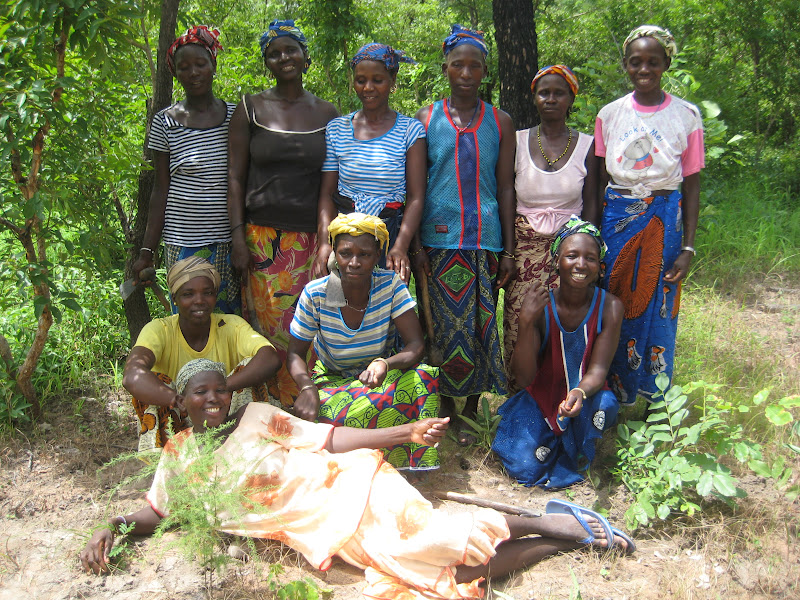
Nafadji Care Group: Top Row (right to left): Fatoumata Kanoute, Bantan Keita, Suaro Damba (holding Debby Diallo), Kaba Damba, Mbamoussa Damba (holding Liz Diallo), Numo Sedicora, Kanio Diakhaby, me. Bottom Row (right to left): Makhan Macalou, Aminata Keita, Bintou Damba, and Mbamoussa Dangokho's daughter (replacing her for the day). Missing: Mbamoussa Dangokho and Minte Fofana

Sewing up the holes in mosquito nets on World Malaria Day

Washing mosquito nets

Monday, April 23, 2012

Jeune Relais Training

The cycle of teenage pregnancy is difficult to break.  Mbamoussa gave birth to Diabou when she was 15.  She now has 9 children and is only 30 years old.  She has wanted so much for her children to succeed, especially her oldest daughter.  She worried about her and talked about how she wanted so badly for her daughter to finish school.

I recently heard that Diabou, who is currently 15, is pregnant.  My heart dropped when I heard the news, because I knew how much it meant to Mbamoussa for her daughter not to follow along the same path she had.  Diabou is a good student and was selected to be a Student Relais for the training Ian and I had planned.  My head was full of questions, and I didn’t know what my role should be in the situation.   Mbamoussa and Diabou had been keeping the pregnancy a secret, so I felt uncomfortable confronting either of them about it, and I didn’t even know if it was my place to say anything. 

That night, I found myself sitting alone with Mbamoussa outside the compound, and I decided to just ask her straight out if Diabou was pregnant.  I told her I noticed Diabou was getting a little bigger and wondered if she was pregnant.  Mbamoussa confirmed what I already knew, but it was better to hear it from her.  Right then, some others walked over and sat down, so we stopped talking about it.  Later that evening, when I returned to my hut for the night, Mbamoussa followed me and knocked on my door.  This was a big step in our relationship, because she confided in me and explained her fears and worries.  With this conversation being in Malinke, I probably wasn’t as useful as I maybe could have been, but I think we both understood one another.  I asked her if Diabou planned to stay in school, and she said she didn’t know yet.  I think Mbamoussa wants her to continue school, but she doesn’t know how that would be possible.  So many girls drop out due to pregnancy or early marriage.  Only 3 girls have made it to the final year of middle school this past year.  I told Mbamoussa that I wanted to try to help as much as I could to convince Diabou to stay in school.

Ian and I have been planning the Student Relais training for the past 4 months, and we planned to train 12 students (6 girls and 6 boys) to teach others about Sexual Education, Family Planning, HIV/AIDS, STI’s, Early Marriage, Teen Pregnancy, and the Importance of Education.  We knew that these areas were important for students to know about, but it became a lot more real to me once I found out Diabou’s news.  I realized that these students need to be educated about sexual health.  If we had done the training earlier, maybe things for Diabou would be different. 

The 3-day Student Relais training just ended yesterday, and it’s a relief to have that under my belt.  Ian was an amazing work partner, and the training was very effective.  Planning was a challenge though.  I think the most difficult aspect of putting this training together was the village and health system politics.  A few weeks before the training, some villagers told us that we should have put together a committee of villagers for the event and that there had to be a committee meeting before the training could happen.  Unfortunately, no one had told us this earlier when the information would have been more useful.  Ian and I received grant money from USAID, but they require a community contribution as well.  The chief did not seem to understand this concept and was unhelpful.  The week of the training, we finally put together a committee, had a meeting, and figured out the final preparations for the training.  We had to organize for a group of women to cook lunch each day and had to mobilize the community to come to the graduation ceremony at the end of the training.  So many little things came up that needed to be done that I never would have thought of.  For example, I had to find students to search for bunches of wood in the bush for the women to make fire with to cook the lunch.  Getting the T-shirts we had made in Dakar was a fiasco.  We had to plan a menu and buy all the ingredients from various places for the lunches and coffee breaks.  We had to get money out of the bank to pay for everything, and both ATM’s in Kedougou were broken.  On top of that, Ian and I had to plan the curriculum and work with the head midwife at the hospital to figure out exactly what the students would learn. 

Finally, the day of the training, I thought we had everything in order and that we were set for a smooth training.  Wrong.  The morning of the training, Sarr dropped a huge bomb.  He pretended everything was fine right up until the training was about to start, and then he refused to come and told me he could shut our training down since Nafadji is within his health zone and he is in control of all the health activities that happen.  He was angry that I had asked the head midwife in Saraya to lead the training instead of him.  He had offered zero help the entire 4 months leading up to the training and was all of a sudden saying I made a huge mistake in not doing everything through him.  I was furious.  Ian and I had worked so hard to get everything together, and the students were excited for the training, and now Sarr was making it all about him and his authority.  Through gritted teeth, I apologized for not involving him more, and he seemed to accept my apology.  He no longer threatened to ruin our training, but he still refused to have any part in it.  But, the show went on.

We got an amazing group of 12 students for the training.  They were excited and motivated to learn.  We did a pre-test before the training started to gauge their base knowledge, and we found that they didn’t know much about sexual health.  By the end, they were able to answer every question and showed phenomenal improvement.  The head midwife in Saraya was a great leader and taught the students about Puberty, Sex, Family Planning, HIV/AIDS, and STI’s.  Every one of those students now knows how to properly do a condom demonstration, and they are excited to teach their friends.  Along with the midwife’s lessons, Ian and I led games and other activities throughout the training.  My favorite part was when we did a tea time health talk, where we all sat around, drinking tea, and talking informally about health.  We learned how much the students were retaining, and listened as they taught us all about everything they had learned.  The last day, we did a “Draw Your Future” activity, where each student drew where they wanted to be in 10 years.  A lot of them want to be doctors, teachers, nurses, and midwives.  We had them write out a step-by-step plan for how to achieve their goals, and I hope they get there! 

Having Diabou as a trainee made me feel a little awkward as the head midwife talked about the risks of teen pregnancy and how bad it was not to protect yourself.  I was happy to hear her talk about how important it was to stay in school even if a girl becomes pregnant.  She said that the girl had made one mistake by getting pregnant but didn’t need to make the second one by dropping out of school.  I hope Diabou was listening.  Ultimately it’s her life and her choice, but I would love to see her become a teacher, which is what she said she wanted to be some day. 

This training really opened the lines of communication about sexual health in the village.  We had a great turnout for our graduation ceremony, and our trainees sported their new green “Jeune Relais” t-shirts.  The community knows what these students have been trained in and sees the value in the training.  Too many young girls get pregnant or married too young, and now more students will have knowledge about how to plan and protect themselves. 

Ian and I are very excited to work with this group of Student Relais in the coming year.  We will continue to give them homework assignments and work with them to educate their peers and local communities.  This weekend, they will be doing a health talk in front of the community about some of the subjects they learned.  Within the next month, each Jeune Relais will teach at least 5 other friends about something they learned.  Slowly, the knowledge will spread. 

Despite all the hiccups, I think the training was a big success!  The students learned a lot and are ready to teach the community.  A topic that may have seemed taboo before is becoming easier to talk about with the community.  Hopefully we see less girls dropping out of school in the coming years and can start working to break the cycle.


The Jeune Relais Group